


At a glance, an interior designer, a land surveyor and a baker may not share anything in common. But if you dive deeper, you'll notice that these three occupations use a certain degree of geometry equations in their day-to-day work.
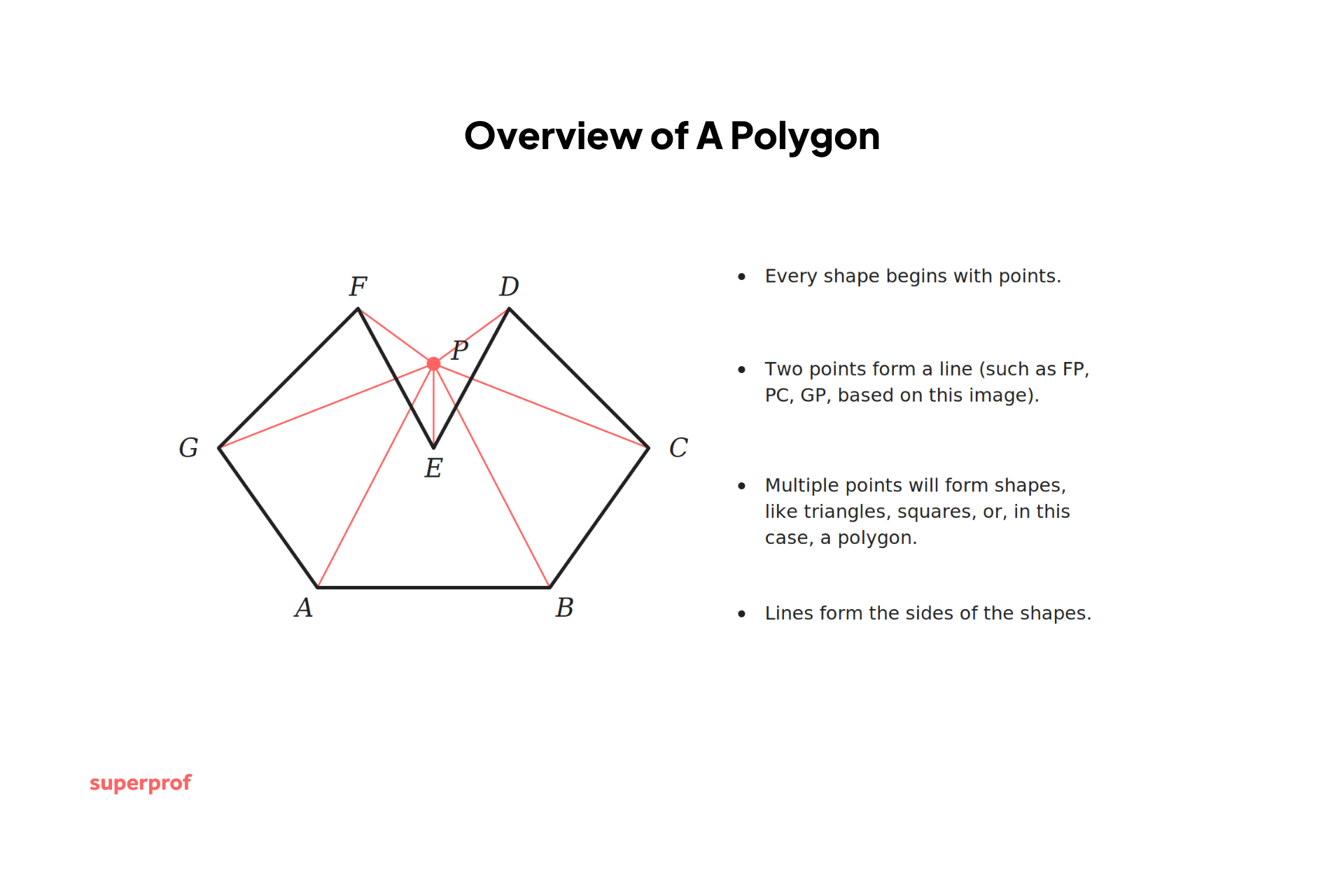
🔶 Points and Lines
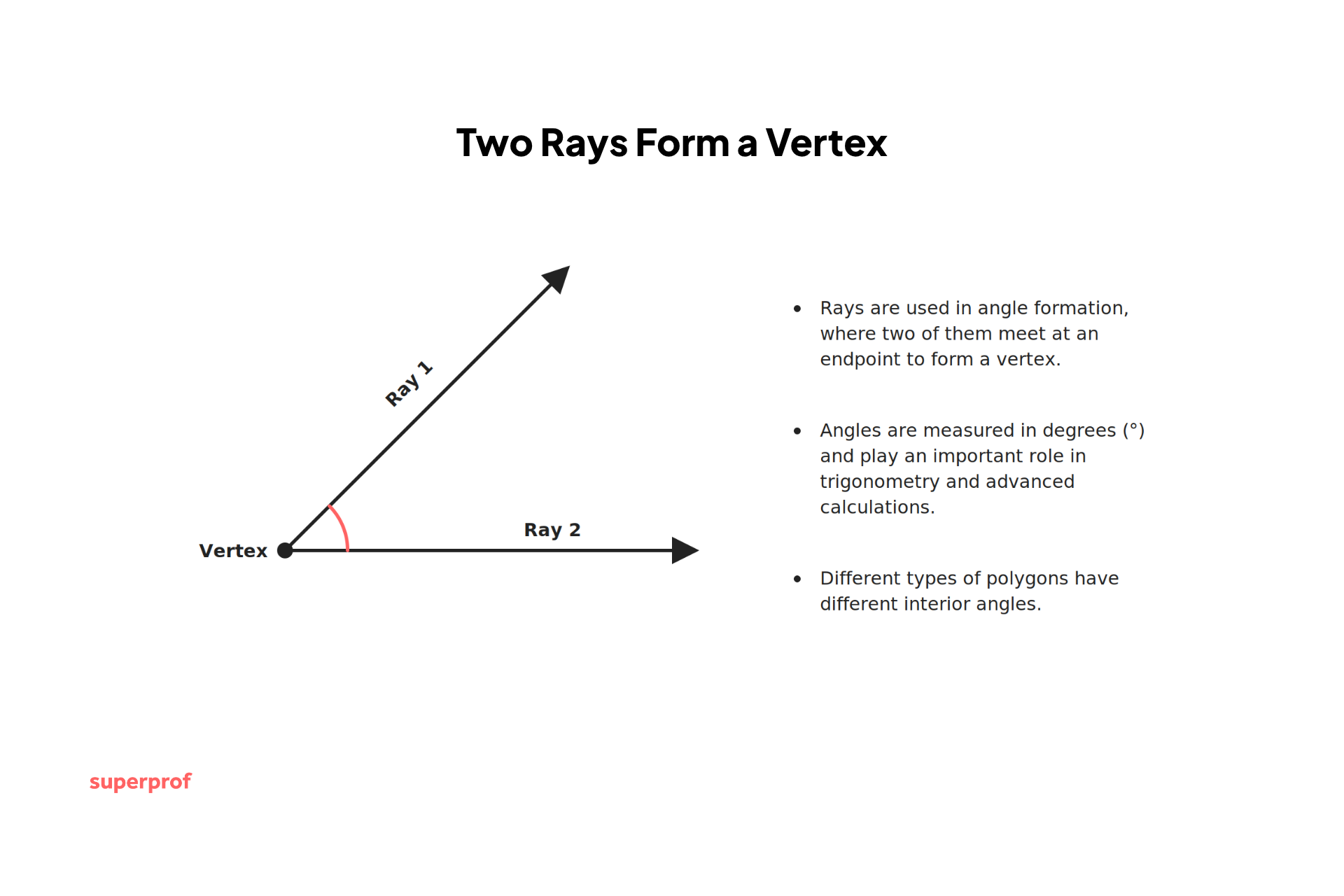
🔷 Rays and Angles

🔲 2D Geometry Formulas
2D geometry formulas are used for flat shapes with length and width, typically to measure perimeter and area. The shapes that we'll discuss here are triangles, quadrilaterals, and circles.
| Shape | Perimeter / Circumference | Area | What to remember |
|---|---|---|---|
| Triangle | P = a + b + c | A = 1/2 × b × h | Add all three sides for perimeter; use the base and perpendicular height for area. |
| Equilateral triangle | P = 3s | A = (√3/4) × s² | All three sides are equal. |
| Isosceles triangle | P = 2a + b | A = 1/2 × b × h | Two sides are equal, and the third side is the base. |
| Scalene triangle | P = a + b + c | A = 1/2 × b × h | All sides are different lengths. |
| Square | P = 4s | A = s² | All sides are equal. |
| Rectangle | P = 2(l + w) | A = l × w | Length and width are different. |
| Parallelogram | P = 2(a + b) | A = b × h | Use the perpendicular height, not the slanted side. |
| Rhombus | P = 4s | A = 1/2 × d₁ × d₂ | All sides are equal; area uses diagonals. |
| Trapezoid | P = a + b + c + d | A = 1/2 × (b₁ + b₂) × h | The two parallel sides are used in the area formula. |
| Circle | C = 2πr or C = πd | A = πr² | Circles use circumference instead of perimeter. |
Here's what different key symbols mean for the formulas:
- a,b,c = side lengths
- s = side length
- l = length
- w = width
- b = base
- h = perpendicular height
- r = radius
- d = diameter
- d1,d2 = diagonals
- π = pi, approximately 3.14
🧊 3D Geometry Formulas
Now, let's explore some 3D geometry formulas used for shapes with length, width and height. The examples of shapes that we will be looking at are polyhedra (cube, cuboid, prism), cylinders, cones and spheres.
| Shape | Surface Area | Volume | What to remember |
|---|---|---|---|
| Cube | SA = 6s² | V = s³ | All edges are equal. |
| Cuboid | SA = 2(lw + lh + wh) | V = l × w × h | Length, width, and height may all be different. |
| Prism | SA = 2B + Ph | V = B × h | B = area of base, P = perimeter of base, h = height. |
| Cylinder | SA = 2πr² + 2πrh | V = πr²h | Two circular ends and one curved surface. |
| Cone | SA = πr² + πrl | V = 1/3 × πr²h | l = slant height. |
| Sphere | SA = 4πr² | V = 4/3 × πr³ | Only radius is needed. |
| Pyramid | SA = B + 1/2Pl | V = 1/3 × B × h | B = area of base, P = perimeter of base, l = slant height. |
| Frustum of a cone | SA = π(R² + r²) + π(R + r)l | V = 1/3 × πh(R² + Rr + r²) | R = larger radius, r = smaller radius. |
| Torus | SA = 4π²Rr | V = 2π²Rr² | R = distance from center of tube to center of torus, r = tube radius. |
Here's what different key symbols mean for the formulas:
- s = side length
- l = length or slant height, depending on the shape
- w = width
- h = height
- r = radius
- R = larger radius
- B = area of base
- P = perimeter of base
- π = pi, approximately 3.14
- ² = squared
- ³ = cubed
➡️ Coordinate Geometry Formulas
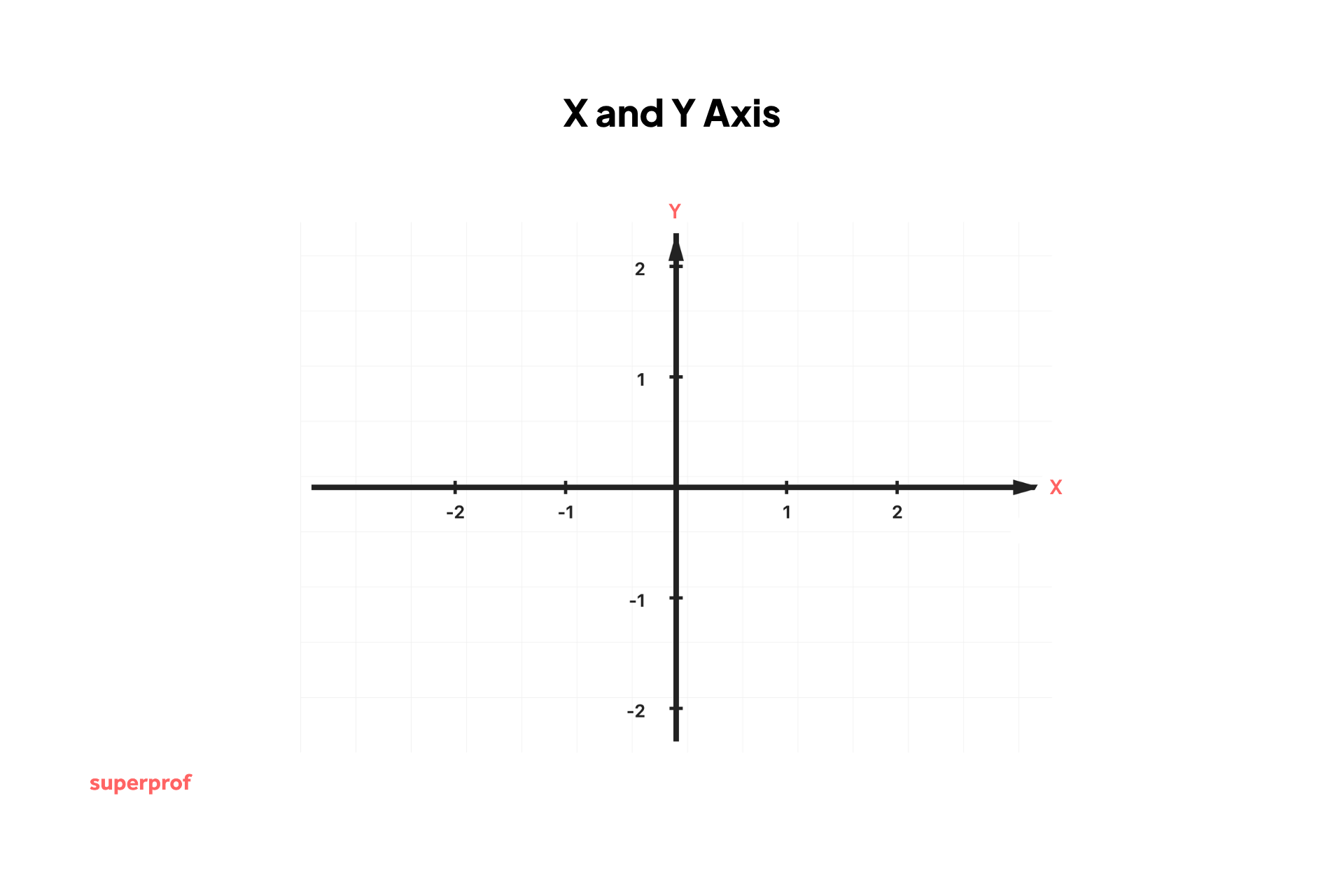
Next, let’s look at coordinate geometry formulas used in the Cartesian plane, a 2D graphing system for locating points and drawing shapes.
The points are identified by using ordered pairs (x,y), where x is the horizontal position and y is the vertical position.
- (2,3) means 2 units right and 3 units up
- (−1,4) means 1 unit left and 4 units up
The four important formulas under coordinate geometry include:
- Distance formula (how far apart are two points)
- Midpoint formula (centre of a segment)
- Slope formula, where m = slope
- Equation of a line in different forms
Here's an overview of the formulas:
| Formula Name | Formula | Purpose |
|---|---|---|
| Distance Formula | d = √((x₂ − x₁)² + (y₂ − y₁)²) | Find the distance between two points. |
| Midpoint Formula | M = ((x₁ + x₂)/2, (y₁ + y₂)/2) | Find the midpoint of a line segment. |
| Slope Formula | m = (y₂ − y₁)/(x₂ − x₁) | Find the slope of a non-vertical line. |
| Slope-Intercept Form | y = mx + b | Write the equation of a line using its slope and y-intercept. |
| Point-Slope Form | y − y₁ = m(x − x₁) | Write the equation of a line using a point and its slope. |
| Standard Form | Ax + By = C | Write a linear equation in standard form. |
| Section Formula | P = ((mx₂ + nx₁)/(m + n), (my₂ + ny₁)/(m + n)) | Find the point that divides a segment internally in the ratio m:n. |
| X-axis | y = 0 | Represent the horizontal coordinate axis. |
| Y-axis | x = 0 | Represent the vertical coordinate axis. |
| Parallel Lines | m₁ = m₂ | Check whether two non-vertical lines are parallel. |
| Perpendicular Lines | m₁m₂ = −1 | Check whether two non-vertical lines are perpendicular. |
Here's an example of how to apply these formulas to this question:
- If you are given two points: and and asked to calculate the distance, midpoint and slope, here's how to go about it:
Distance
Midpoint
Slope
📐 Trigonometric Applications in Geometry
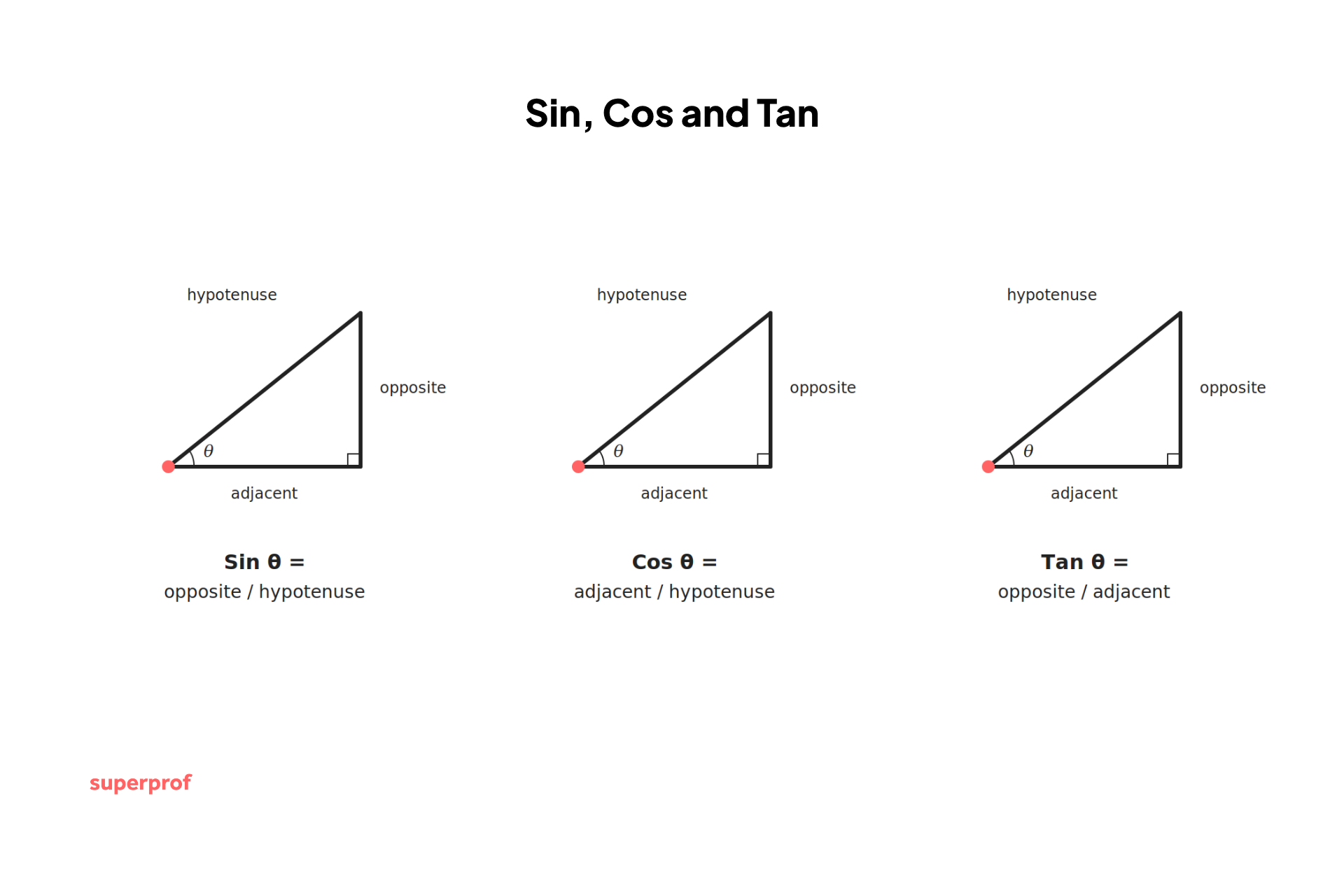
Trigonometry is a branch of math that deals with angles and side lengths in triangles. 2 The basic trigonometric ratios for sin, cos and tangent are only applicable for right-angled triangles, and you need at least one angle to use either one of them.
Right triangles have the following characteristics:
- They have three sides
- They have a 90° angle, looking like a perfect L-shape.
- The side opposite the right angle is called the hypotenuse (and it’s always the longest side)
- The other two sides are called adjacent and opposite
Another popular equation or geometry theorem associated with right angles is none other than Pythagoras' Theorem. It is only used to calculate missing side lengths and not angles.
The formula is:
Let's look at this sample question:
- A ladder leans against a wall forming a right triangle: Distance from wall = 6 m, Ladder length = 10 m. Find the wall height
The wall height: h=100−36
h=
h=8 m
Don't forget to check out this geometry guide for beginners.
🧱 Advanced Geometry Formulas
Moving on, we will look at various geometry formulas and equations involving more complex shapes, such as ellipses and hyperbolas, as well as complex solids like frustums and toroids.
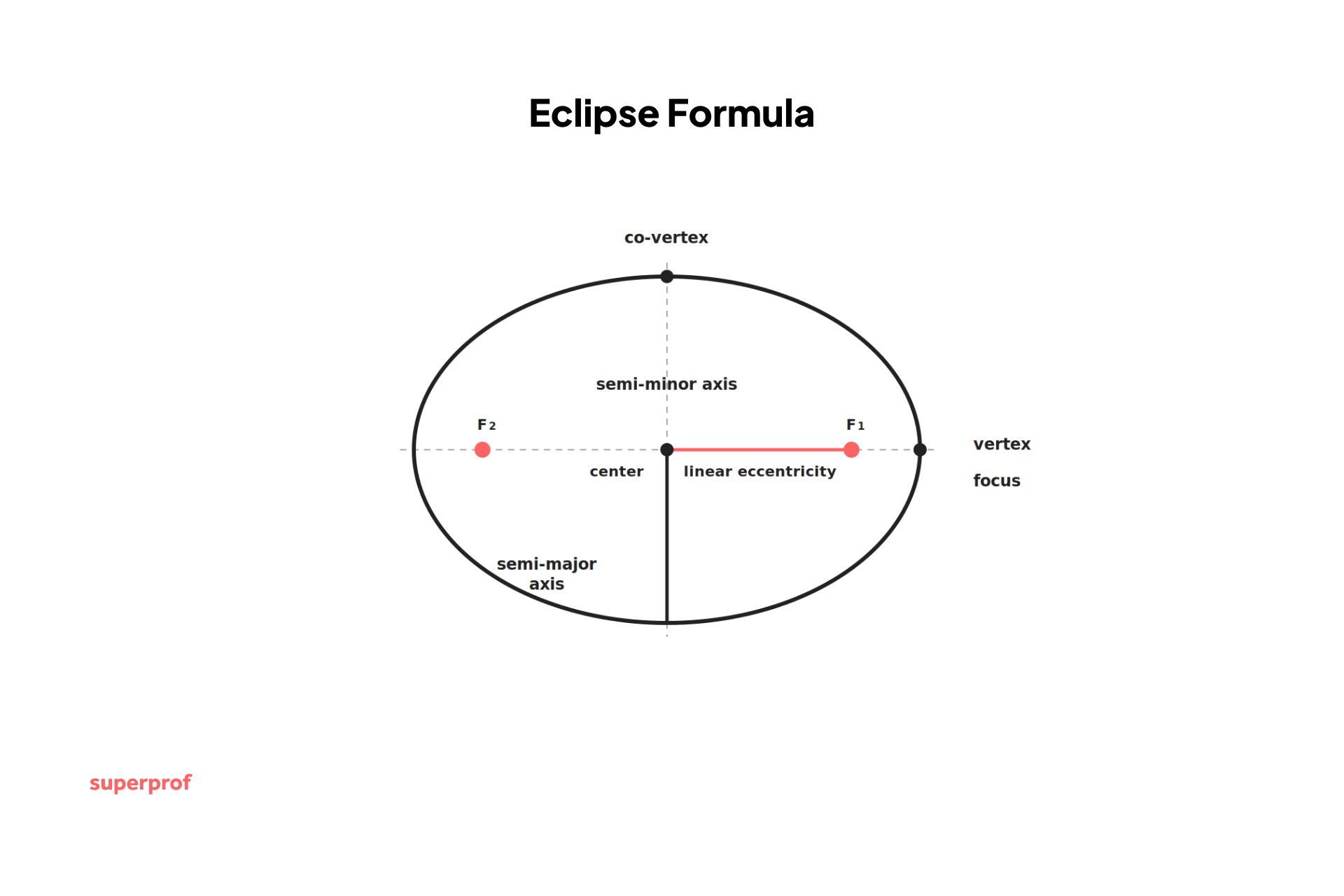
- An ellipse is essentially a stretched circle. It looks like an oval with a smooth, closed curve 3
- It has two axes along the x-axis and the y-axis: the major axis and the minor axis
- It has a centre point and is symmetrical
The ellipse equation plays a big role in the field of geometry to help us plot the ellipse accurately on a graph, find the intercepts and perform calculations on planetary orbits (similar shape) and satellite motions.
The Formula: . Here are what the symbols mean:
| Symbol | Meaning | Simple explanation |
|---|---|---|
| x | x-coordinate | Horizontal position of a point on the ellipse 📍 |
| y | y-coordinate | Vertical position of a point on the ellipse 📍 |
| a | semi-major axis | Distance from the center to the widest point of the ellipse (long radius) ➖ |
| b | semi-minor axis | Distance from the center to the narrowest point of the ellipse (short radius) ➖ |
| 1 | boundary condition | Only points that make the equation equal to 1 lie exactly on the ellipse ✔️ |
On the other hand, hyperbolas have two different formulas depending on their orientation: horizontal or vertical.
Horizontal hyperbola
Vertical hyperbola
Like the ellipse, hyperbola formulas are also widely used in calculations involving satellite and space trajectories, in addition to telescope and antenna design and even navigation systems.
For more complex solids like frustrums and toroids, you can use the following formulas to calculate their respective volumes.
Here's an overview of the symbols and variables of the formulas:
| Symbol | Meaning in a Frustum of a Cone 🔺 | Meaning in a Torus 🍩 |
|---|---|---|
| V | Volume of the frustum | Volume of the torus |
| π | Mathematical constant pi | Mathematical constant pi |
| h | Perpendicular height of the frustum | Not used in the standard torus volume formula |
| R | Larger radius of the frustum | Major radius: distance from the center of the torus to the center of the tube |
| r | Smaller radius of the frustum | Minor radius: radius of the tube |
Frustums are commonly used in various everyday application designs like buckets, paper cups and lamp shades, while toroids are usually seen in mechanical engineering parts, toroidal transformers and inductors.
Frustrum (A cone with the top removed)
Toroid (A ring or doughnut )
🎯 Practical Applications of Geometry Formulas
We hope you have gained a comprehensive understanding of these geometry equations and how to apply them mathematically. Now, let's switch gears to look at them through a more practical lens. 4
The three most common industries and fields across the globe that use geometry formulas are:

Engineering
- Triangle formulas in structural engineering
- Surface area calculations for bridges and towers
- Volume measurements for high-rise buildings
- Cylindrical volume calculation in mechanical engineering

Architecture
- Area formulas help determine room size and material needs for floor plan design
- Use trigonometric ratios for roof and staircase design
- Use the circle circumference formula when designing domes for stadiums, museums or religious buildings

Physics
- Distance formulas to help determine speed and trajectory when planning GPS systems or space exploration
- Using ellipse equations in orbital mechanics
- Calculating distance between stars
- Measuring planetary orbits and helping predict satellite paths (must-have knowledge for astrophysicists)
Find the best math tutors near me.
💡 Problem-solving Examples Using Geometry Formulas
Here are some examples of how you can unlock these formulas to make your life more efficient.
A rectangular room measures: 9 m × 6 m (Area)
If each tile covers: 0.25
Doing this calculation in advance can help you to avoid material waste and installation efforts. In the long run, you'll save a lot because you have avoided cost overruns.
Let's look at another example.
The given details of the swimming pool are:
20 m long, 8 m wide and 2 m deep
Calculation: V=lwh (Volume = length x widthx height)
We hope you have enjoyed reading this article. May you find great delight in mastering these geometry equations in your studies as well as using them effectively in various real-life scenarios. All the best!
In geometric and physical applications, it always turns out that a quantity is characterised not only by its tensor order, but also by symmetry.
Hermann Weyl
References
- Geometry in Daily Life - Definition, Applications, Uses, Examples. (2023, September 16). SplashLearn - Math Vocabulary. https://www.splashlearn.com/math-vocabulary/geometry-in-daily-life#5-uses-of-geometry-in-daily-life
- What Is Trigonometry? Definition, Formulas & Applications I Learner I The World’s Best Online Tutors. (n.d.). Www.learner.com. https://www.learner.com/blog/what-is-trigonometry
- GeeksforGeeks. (2024, February 12). Applications of Geometry. GeeksforGeeks. https://www.geeksforgeeks.org/maths/applications-of-geometry/
Summarise with AI:
Did you like this article? Leave a rating!

 Loading...